My Journey with the Didgeridoo

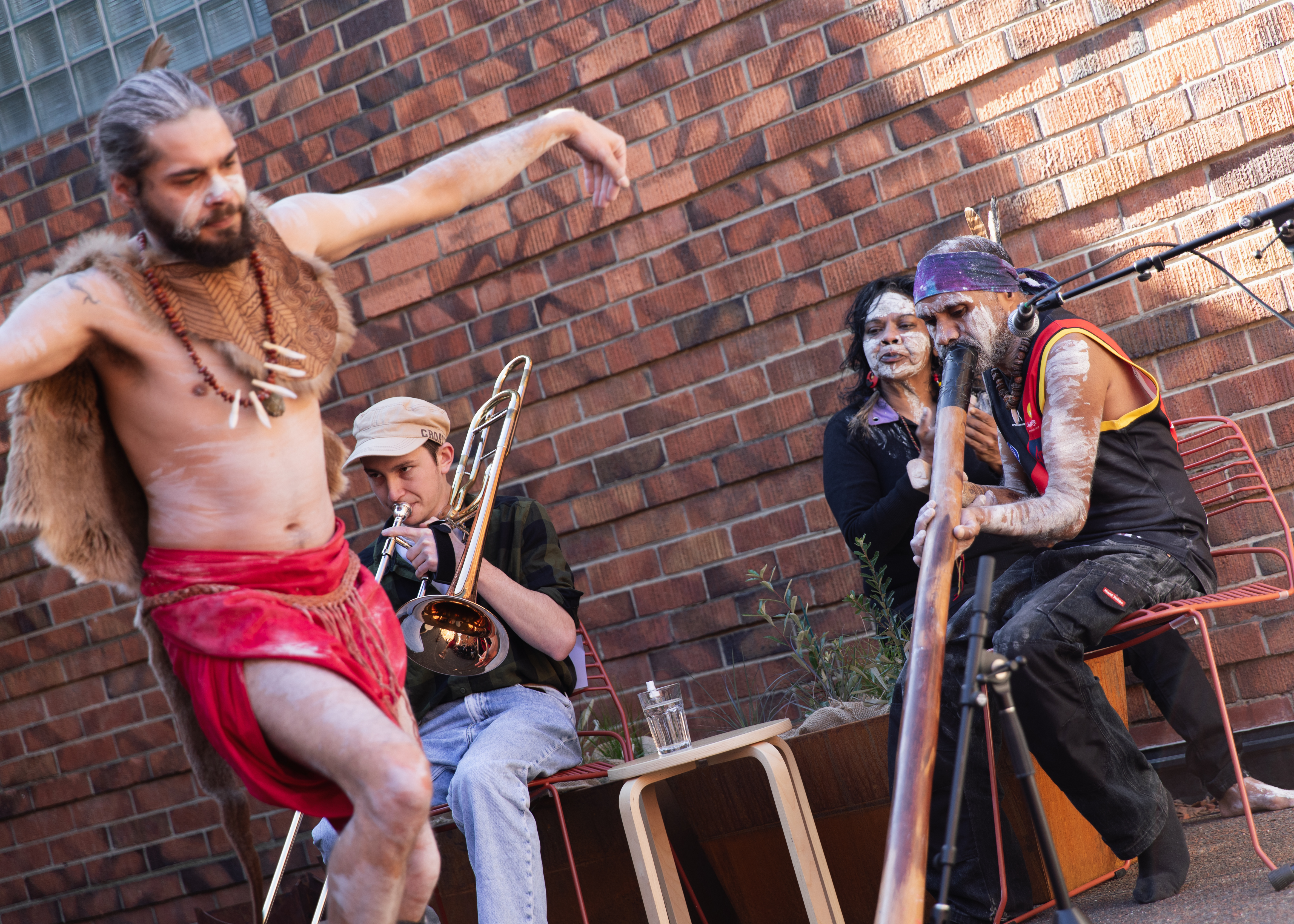
RImage: Amos Roach’s 6-seasons ensemble and the Murrundaya Yepengna Dance Troupe. Dancers Brent Watkins and Darren Turner Jnr, and Shiralee Hood on Bipidis (clap sticks).
I had a brief but influential Yidaki/Didgeridoo lesson with Balladong-Noongar Elder Mort Hansen when I was fifteen, who handed me his instrument to try whilst picking up a vacuum cleaner pipe to teach with. Deeply inspired by our lesson, I continued to practice at home for the next three years with the closest thing I had to a Didgeridoo – my trombone. Following my growing interest in Indigenous music, I attended university classes in Noongar culture, where I became concerned with my lack of ongoing cultural consultation while studying Didgeridoo music, especially in the context of my learning it through a different interface.
A few years later, I dedicated my Honours research project at Melbourne University towards better evaluating how my approach to Didgeridoo playing on the trombone fit (or didn’t) within current ethical and cultural frameworks. It was here I met musician, dancer, and proud Djab Wurrung/Gunditj Mara and Ngarrindjeri man, Amos Roach. Together we collaborated on a series of public performances that explored my ‘trombone-Didgeridoo’ approach, where I took on the role of a Didgeridoo student following and imitating the songs of the mentor. This finally gave me opportunities to explore my passion for Indigenous Australian music in practice, to consult knowledgeable cultural practitioners, and to genuinely interrogate my emerging role in this cross-cultural space.
In 2023 I was also fortunate to meet David Yipininy Wilfred, a Ritharrgu man and traditional djunggayi (manager) of the manikay (songs) of the country of Nyilipidgi, and Daniel Wilfred, a Yolngu song man and Wägilak ceremonial leader from Ngukurr, as part of a two-week creative development program with the Australian Art Orchestra. Learning from and playing music with Daniel and David further deepened my love for First-Nations cultures, and taught me more about how I might go about building a positive intercultural musical practice. One of their most resonant lessons to me was around the importance of connecting music with storytelling to maintain and build what they call raki; a string, both literal (made from bark fibres) and philosophical – threads connecting people and communities together and connecting us with our predecessors and successors to create a lattice of knowledge and kinship. The importance of building epistemologies, identity, and connection through story sharing has deeply shaped the way I approach performance, the structure and tone of my research, and even the way I have gone about travelling and meeting new people around the world. By grounding my art, writing, and new friendships with my story, I hope to strengthen the raki, stay connected with the songlines, and pull together new people as knots in the string.
It’s a tricky thing to play Didgeridoo techniques on the trombone, I still struggle with it. The smaller bore and necessary adjustment of the embouchure make clean and fast articulation hard to pull off, and I’ve only just started attempting to build polyrhythmic patterns into my playing. It’s also still too difficult to switch smoothly between trombone and Didgeridoo playing styles, but I’m sure that most of these can be ironed out with practice and patience. I try not to leave my own personal creative voice and the instrumental semiotics of the trombone behind, I think it’s important to celebrate what makes the instruments both similar and unique. I bring out the trombone’s beautifully bright and metallic tone, the use of the slide, thumb triggers, and the easily accessible upper partials. I’m sure there are many more things to uncover as well.
I pay my respects to the ancestors who have passed and our Elders who now guide us, as well as their families. I’m grateful to be living on this ancient country and make my art here. I hope that the work I do honours the depth and meaning that the Didgeridoo and its musical traditions carry. The traditional peoples have lived on this country for at least (I wouldn’t be surprised if we discover it’s even longer) sixty five thousand years, and I recognise their continuing sovereignty.