Archipelago
for chamber orchestra
flute, oboe, clarinet, bassoon, horn, trumpet, trombone, tuba, percussion, harp, piano, 4 violins, 2 violas, 2 cellos, and double bass
Premiered on January 19, 2024, at Elder Hall, South Australia, by the Australian Youth Orchestra National Music Camp Tutor Chamber Ensemble.
score excerpt below – full score available for purchase at the Australian Music Centre

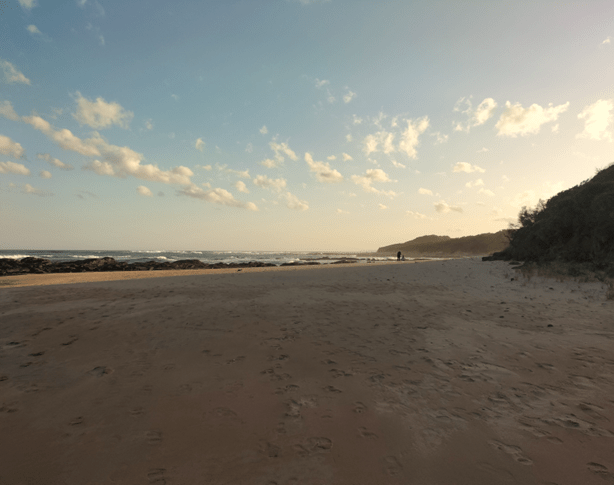
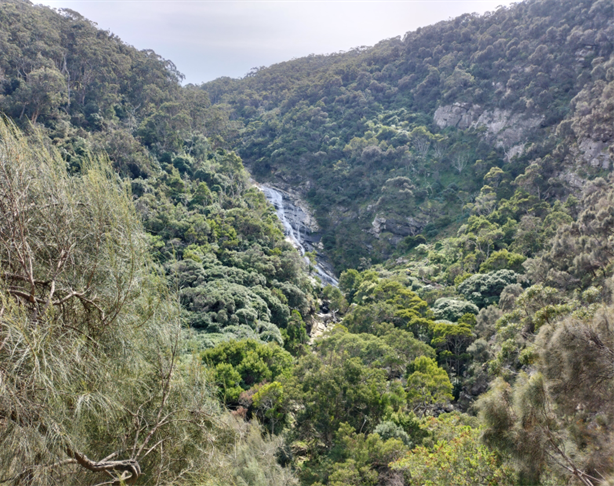
This composition was inspired by a series of hikes I took around Apollo Bay, Gadubanud Country, Victoria (pictured below). These hikes were taken in silence, and repeated each day, focusing on the way the surrounding natural sounds emerged and receded with each shift in terrain. They included farming pastures, dense bushlands with birds and insects, rocky shorelines, and fast-moving streams. Each environment had its own suite of qualities that rotated across the day and with the weather.
Archipelago grew out of this deep listening and close study of the ways the natural soundscapes organise themselves. The piece unfolds as a succession of self-contained, quasi-improvised sonic events that surface, overlap, and fade within their own local area, forming soundworlds that are emergent, constantly shifting, and closely interwoven with their neighbours. Rather than creating a strong sense of forward motion, transience is treated in a way that places the listener in motion instead, as if moving through a varied and gradually evolving landscape. This is reinforced practically by the function of the conductor, who has the freedom to cue in each new layer at their own pace, like a hiker choosing their walking pace, with the ability to dwell in a particular area if they wish.
Instrumental layers behave like independent inhabitants of the terrain, lingering as one sonic area gives way to the next, so that environments bleed into one another. These overlaps form boundary zones between sections, similar to the edges between natural environments where elements from both spaces coexist. The resulting soundworld is shaped less by linear development and more by proximity and continuity between related spaces – areas that share many of the same sonic inhabitants, but in different densities. The individual musical cells are designed to act, as well as sound, like organic inhabitants: they move with metrical independence, engage in rhythmic improvisation within melodic and harmonic shapes, and maintain subtle relationships with other cells that suggest shared lineage or genetic cousinship